Seed Lab gives children time to look closely at a plant, notice a change and ask what might happen next.
I chose a French bean so the pictures could follow a particular plant. The aim is to support looking and talking about growth, with clear space between an illustrated example and something a family has actually observed.
How it works
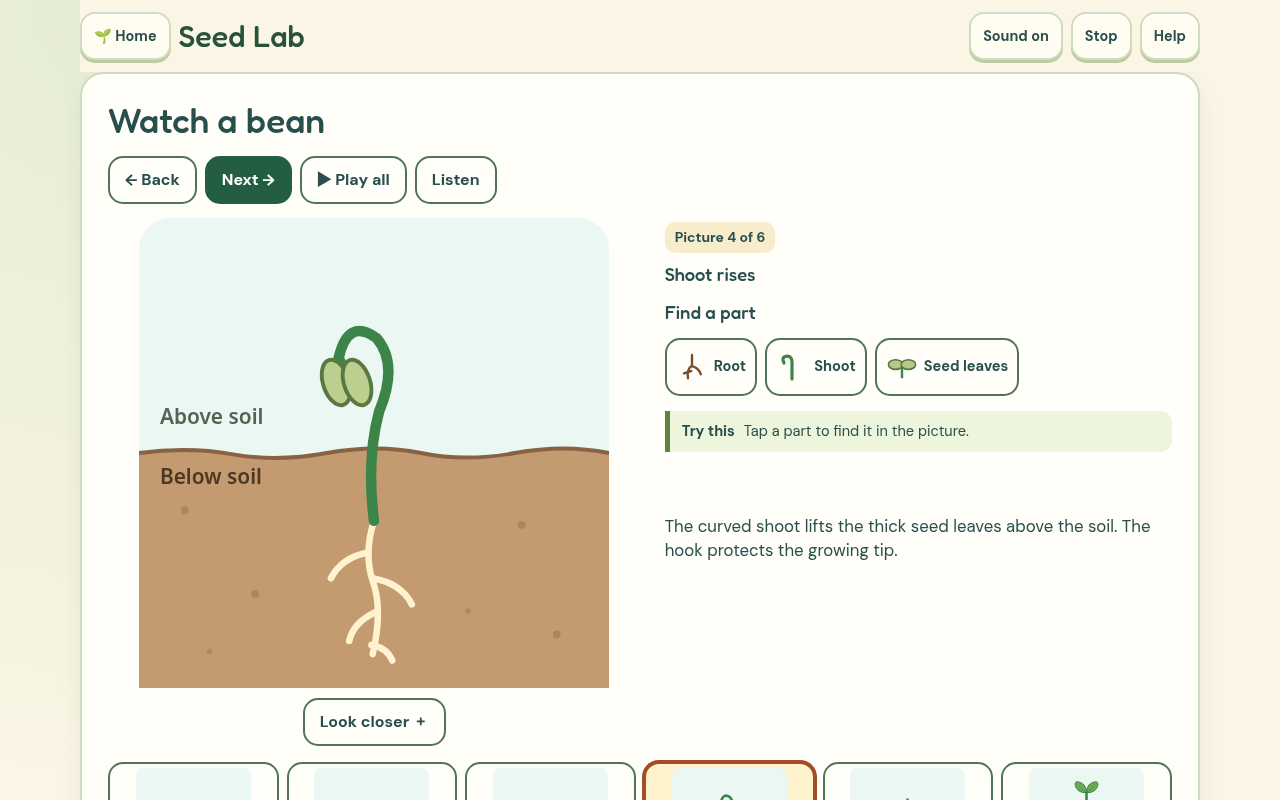
The large bean pictures let you inspect the root, emerging shoot, seed leaves and true leaves. You can look more closely at a part, put stages in order and say what changed. The pictures are steps in an explanation, not a promise that every bean reaches each stage on a particular day.
Compare offers different growing conditions, with a guess before the reveal and a chance to look back at it. My plant diary lets you keep chosen pictures for separate plants, including no change and not sure. Dates can be exact, approximate or unknown, and the cards can be revisited or printed for use away from the screen.
What needed more care
The anatomy matters. A bean's seed leaves are different from its later true leaves, and the emerging shoot needs the right hooked form. The diagrams use deliberate geometry and labels so an attractive picture does not teach the wrong part.
A diary entry records what a family chose to report. It is not a photograph or a diagnosis, and an uncertain date stays uncertain. The game also avoids treating the tallest seedling as automatically the healthiest one.
Checking the learning
The original report drew an important line between a guess, a picture sequence and a real observation. The game now makes that distinction more explicit. When the game asks what changed, there is more than one sensible option to inspect. It accepts the changes visible in the pictures, including root growth, then marks the relevant part and explains it aloud. An optional discussion connects the illustrated example to your own diary without claiming to know what your real plant has done.
What I built it with
I used HTML, CSS, JavaScript and SVG for the bean diagrams, part labels and picture diary. The sun uses an approved render from the existing Moho workflow. Plant stages are deliberate illustrations rather than generated pictures of what a particular seed must do.
Codex helped me build and check the game. I generated the complete British English speech recordings locally with Kokoro, so there is no paid AI service needed while you play.
The menus and controls now share Grow Word's locally stored fonts, warm cream colours and rounded buttons. Each game keeps its own play area and pictures.
The game is free to play without an account. Saved work stays in this browser on this device, so clearing browser data can remove it. Once its offline pack has finished saving, the game can be played without a connection.
What I want to check next
The useful next step is growing and observing a real bean with a grown-up. I want the diary to help children notice differences and ask questions, rather than feel that their plant must match a game picture.
This is still an early release. Browser testing and independent design reviews help find software and interaction problems. I still want physical phone checks and observation with children before making claims about independent use or learning gains.