The same object can belong in different groups depending on the question you ask. Sort Detective makes that idea something you can try.
I used shapes with visible features rather than facts a child would have to know about animals or objects. You can look for a circle, a colour, a hole or a pattern and explain the decision from what is on the screen.
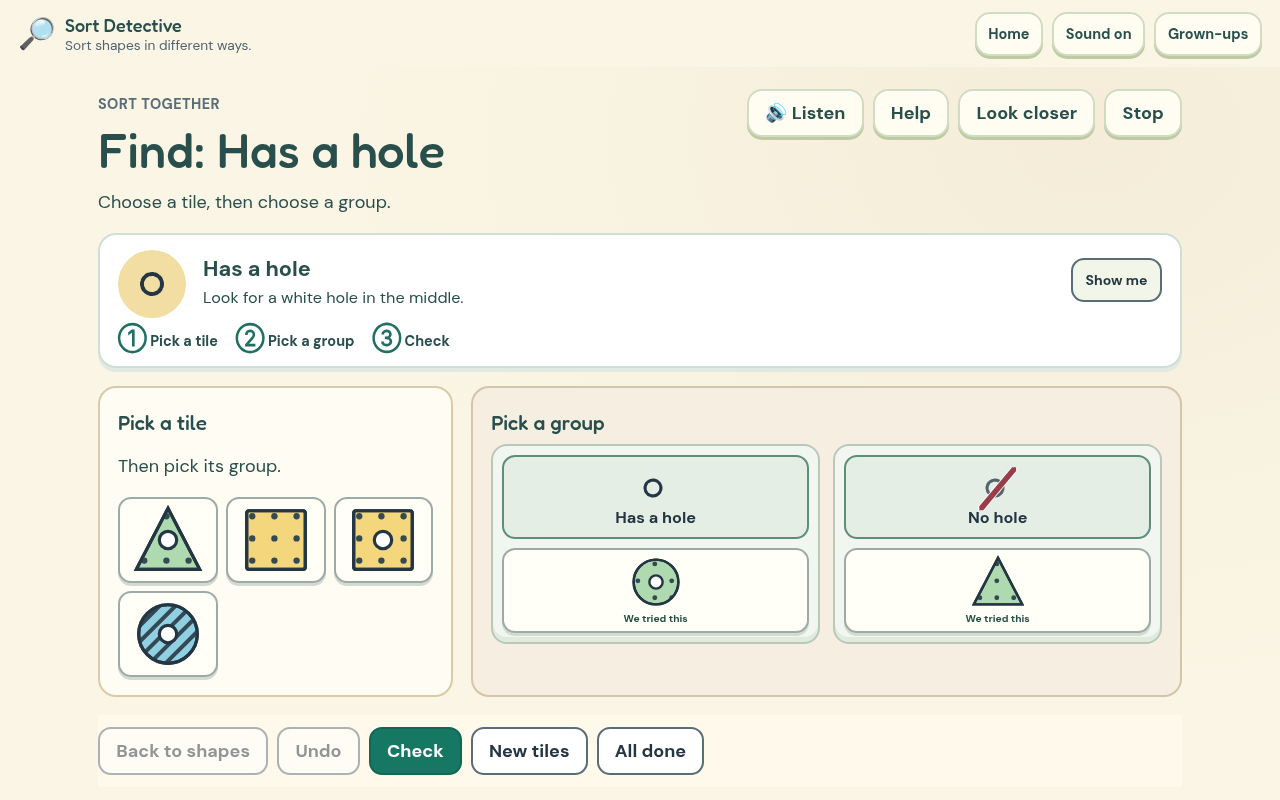
How it works
Start with a pictured rule and put the pieces into groups. Both sides have visual help, including the group that does not match the rule. An optional inspector points out features on the selected piece. Changing the rule keeps the same pieces, so you can see which ones move and which stay together.
Rule Detective hides the rule and gives examples. You can make a guess or ask for another clue. If more than one rule fits what you have seen, the game accepts those possibilities. You can also make your own groups and save a pictured arrangement without being told that a personal grouping has one correct answer.
What needed more care
A negative label such as 'Not circles' is a lot to ask of a child who is not reading yet. The groups now have clearer picture cues, and help describes the visible feature that matters to the current task.
The hidden-rule activity needs to be fair. It checks every candidate rule against the evidence, rather than marking only the developer's chosen rule as correct. Further clues can separate possibilities that initially look equally sensible.
Checking the learning
The original report asked whether a rule still works with an unfamiliar example. After sorting, an optional new tile has a combination of features absent from that set. The rule stays the same, and you can point to the visible feature behind your choice. This is a fresh example within a small, deliberate set of toy shapes; it does not prove that a child will classify every real object correctly.
What I built it with
I used HTML, CSS, JavaScript and SVG so each shape has explicit visible properties. The same rule functions check both a sorted group and a hidden-rule hypothesis. It does not need an AI model deciding whether an answer sounds plausible.
Codex helped me build and check the game. I generated the complete British English speech recordings locally with Kokoro, so there is no paid AI service needed while you play.
The menus and controls now share Grow Word's locally stored fonts, warm cream colours and rounded buttons. Each game keeps its own play area and pictures.
The game is free to play without an account. Saved work stays in this browser on this device, so clearing browser data can remove it. Once its offline pack has finished saving, the game can be played without a connection.
What I want to check next
The next test is listening to children explain why they moved a piece after a rule change. Their reasoning is more useful than how quickly they clear a tray.
This is still an early release. Browser testing and independent design reviews help find software and interaction problems. I still want physical phone checks and observation with children before making claims about independent use or learning gains.